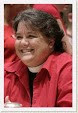
And on a more serious note, Asra Nomani will be speaking at Pacific tonight at 7 pm. She is a Muslim Activist Feminist seeking to shift Islamic views and practices toward women.
The Mosque in Morgantown is about her work in her hometown in West Virginia.
Learn more, buy the DVD, and join the discussion at TheMosqueInMorgantown.com
Wednesday, September 30, 2009

Mammas don't let your babies grow up to be pastors
My college friend and Presbyterian Christian Educator, Sarah Lien Finnerty, found this.
It applies to college chaplains, too!
It applies to college chaplains, too!
Friday, September 4, 2009
Bi-Vocational Congregation
For the past 18 months I have had the privilege to serve as the long-term supply priest for St. Brigid's Episcopal congregation in Rio Vista, CA. My full time gig is here at University of the Pacific. I'm well compensated for this position, and I often work long hours. This means I can't give enough time and energy to St. Brigid's, and I don't have the financial need to justify receiving payment for celebrating Eucharist and preaching weekly, or now bi-weekly. They happily pay my mileage.
Until I discovered St. Brigid's, I basically didn't think this model of part-time ministry was very good for the church or the minister, despite (and because of) having served a congregation part-time before now. I think it's working at St. Brigid's, though, and the Alban Institute article below may highlight why. I have become a bi-vocational priest, and St. Brigid's is a bi-vocational congregation. (I would call them an "Experimental Bi-vocational Congregation.") They are blessed with two deacons - Susan and Derek - who are also bi-vocational, and with lay people who give much of their time, energy, and money to the congregation. St. Brigid's is small, and hopes to grow. Perhaps claiming their bi-vocational nature will be the key to growth - numerical and spiritual - for St. Brigid's and other congregations serving small towns and rural areas.
St. Brigid's is located at 218 California St in Rio Vista. Worship is at 10:30 am on Sunday mornings, and ALL ARE WELCOME!
Until I discovered St. Brigid's, I basically didn't think this model of part-time ministry was very good for the church or the minister, despite (and because of) having served a congregation part-time before now. I think it's working at St. Brigid's, though, and the Alban Institute article below may highlight why. I have become a bi-vocational priest, and St. Brigid's is a bi-vocational congregation. (I would call them an "Experimental Bi-vocational Congregation.") They are blessed with two deacons - Susan and Derek - who are also bi-vocational, and with lay people who give much of their time, energy, and money to the congregation. St. Brigid's is small, and hopes to grow. Perhaps claiming their bi-vocational nature will be the key to growth - numerical and spiritual - for St. Brigid's and other congregations serving small towns and rural areas.
St. Brigid's is located at 218 California St in Rio Vista. Worship is at 10:30 am on Sunday mornings, and ALL ARE WELCOME!
The Bivocational Congregation
by Anthony C. Pappas , Ed Pease , Norm Faramelli
Any garden-variety atheist, agnostic, or even religiously indifferent materialist knows that if—and we do mean if—the church is to survive well into the future in the northern hemisphere it won't be through a linear extension of today's church. Every index of the church as it has been indicates a decline, and many indicate a precipitous decline. So what might tomorrow's different church look like? What should we call it? And what are its qualities?
We believe the bivocational congregation (not to be confused with, but related to, bivocational pastors) offers a viable model for tomorrow's church. A bivocational congregation is a local church that operates upon (and may even self-consciously understand) two callings: the calling of function and the calling of mission. We believe the bivocational congregation is more likely to survive into tomorrow to do God's will and be God's people because it is essentially organized around spiritual realities in tune with God's redemptive work. These include:
• healthy team functioning
• a high commitment to place and to being a ministering presence in that place
• a willingness to die to self, if need be, in the cause of serving others
• an acceptance of this expression of the church as a full expression of the church, not a second-rate, temporary, expedient form of the church
• a willingness to experiment and trust that a higher power has something wonderful in store for tomorrow
We've observed five scenarios that help to illustrate these qualities of bivocational congregations as they exist in very different settings.
The Always-Been Bivocational Congregation
In a little town there is a small church with two to three dozen people that gather on Sunday mornings. They know each other well, and each of them has a role to play that helps keeps the church going. A shopkeeper is their pastor, a school teacher their treasurer, and a retired woman their clerk. This congregation needs someone to fill the pastoral role, but a very strictly defined role of preaching and pastoral care. Otherwise, the people expect to work together to accomplish whatever needs doing.
The members' relationships with one another have morphed over the years so that they function as a team. People realize that energy is limited and do not waste much of it on turf battles. New members are incorporated slowly into this dynamic organism. Giftedness and interest are discerned over time and offered and used for the common good. This bivocational congregation functions as a simple organism. Each part has a role to play. The pastor is important but not crucial. In fact, this type of congregation can keep on going for long periods of time without a pastor, if need be.
They know what needs to be done (and what doesn't) and who is going to do it (and who isn't). Yes, their ministry is basic and not extensive. But they own it, they do it, and they will keep on doing it indefinitely. And maybe that is enough.
The Rooted-Here Bivocational Church
In an ethnic, blue-collar section of a large city, a federated church has over the years combined congregations from several different faith traditions. The parish has existed for over a century to minister to the people of its neighborhood and is an example of what happens when a congregation is truly bivocational. When, after a successful 20-year part-time ministry, the pastor left, the congregation began a search process for a new pastor. Their goal was clear: they desired a clergy companion for a bivocational ministry. There were no illusions about getting a replica of their outgoing pastor nor any about switching to a full-time pastor. They sought someone who could serve as pastor and who was as committed to bivocational ministry in this place as they were. That meant having local roots and being committed to doing outreach to the local community. They understand the need for a presence in the local setting—a presence from which outreach programs can flow. Members told us that even if they had the funds available for a full-time pastor, they would use those funds in other ways, especially for community outreach. The congregation understands the need for roots in a community, and it also understands that the concept of bivocational ministry is not just a clergy thing—that it needs to be imbedded in the minds and hearts of all of the members.
This bivocational congregation was missional long before the term came into vogue. They know that their internal life and health depend on their external service. Churches in their neighborhood that didn't understand this have long since closed while this congregation lives incarnational ministry right there in their neighborhood, and consequently it, too, lives.
The Transitional Bivocational Congregation
One congregation emerged from the closing of three Methodist churches in 1966. Today it is in the midst of what it calls its Five-Year Holy Experiment, which involves two congregations working together in the same building. One is a small English-speaking congregation and the other is a new, large, and growing congregation primarily of Korean heritage. The English congregation is bivocational, with a call to live its own life as a congregation, yet also with a call to house and nourish the Korean congregation.
A church council, made up of five members from each congregation, meets monthly. Church committees also comprise members from each congregation. The treasurer of the church was appointed from the Korean congregation, a move supported by the English congregation. The budget for the church is supported by both congregations, with some help from the Methodist District organization. Lay leaders in the English congregation monitor telephone calls coming to the church answering machine and follow up as needed—for both congregations. They also lead a weekly Bible study session open to all. One Sunday a month both congregations worship together.
The English congregation is concerned about its continuing decline in numbers, but its overall attitude is one of joyful celebration for the blessings of the present and the unknown but promising future of this vibrant parish venture. Where will they end up? God only knows, but this transitional bivocational congregation is enjoying the ride! It is ready to die to self—the worship style they are accustomed to, their identification with "our" pastor and building, indeed their whole self, if need be—to see that ministry to their community continues. Unlike so many other congregations that ensure their death by holding on tightly to life as they have known it, this congregation will live on—possibly in resurrected form and speaking Korean! They understand that letting go of what has been is the only way to see what will be.
An Experimental Bivocational Congregation
Five small, centuries-old Episcopal churches sit sprinkled around a river valley. A few decades ago, each struggled to make ends meet, to maintain its high-maintenance building, to keep its Sunday school staffed, and to manage with a part-time rector. Then along came a rector who introduced to them a concept he called "clustering," an arrangement in which certain functions are collectively managed by a board comprising members from the different churches in the cluster.
Under the cluster arrangement, each parish maintains its own building and vestry. Each votes its own budget and raises its own funds. Each may have its own ministry in its own community. And each sends representatives to the cluster board. There, such synergies as common missions, Christian education, music, and social activities may be developed. Clergy coverage for the worship of each parish is arranged on a rotating basis. Other staff members contribute from their skills and calling as the cluster board determines best. What this means in practice is that any one parish has access to a wider array of skills than it could afford on its own. But it also means that their pastor is a functionary, rotating in and out of their pulpit every eight weeks or so, according to a set schedule. So parishioners do not develop the same kind of dependence on their pastor that they might otherwise. Clusters call forth the lay leadership of the congregation. Clusters clearly say: The responsibility is yours. The rector will assist you in achieving your call, but he or she is not going to do for you what is yours to do. You are the permanent part of this equation.
The We-Backed-Into-It-and-We-Want-Out-of-It Bivocational Congregation
Unless the concept of bivocational ministry is firmly rooted in the minds and hearts of the congregation, it can fall apart when the pastor leaves. One congregation that was originally organized as a mission in 1893, in recent years has not been able to afford a full-time pastor. They have been served by a succession of bivocational pastors and strong lay leadership has emerged in order to maintain and expand the ministry of the congregation. The Sunday school, youth ministry, routine pastoral care, and outreach efforts are organized by members of the congregation. The pastor orders the worship services, presides over the parish vestry, gives encouragement and counsel to the lay volunteers, and makes emergency calls on parishioners.
After their last "permanent" part-time pastor of seven years retired, the congregation struggled to find a successor. In the course of searching for three years, the vestry decided to use the congregation's small endowment to seek a full-time pastor. They hope to be able to support this person at full time for three years, during which time the congregation may grow sufficiently to be self-supporting. If not, they will have exhausted their financial reserves, failed at growing, and possibly become terminally discouraged. Though the laity have taken on significant and fruitful responsibilities in mission and in the life of their church, this church seems to have been simply a congregation with a bivocational pastor rather than a bivocational congregation.
This example, replicated so very often, is not a particularly hopeful one, barring a miracle. The desires deeply rooted in the hearts of the parishioners for their own full-time pastor, to be a "legitimate" church, and to have someone to define and do ministry represent a model of doing church that is unlikely to lead us very far into the future. Exhausting resources in that quest will not be as productive as learning the lessons God desires to teach us in order to move into a new future.
Embodiments of Change
Each of the first of these examples lift up qualities of faithful congregations that may foreshadow the characteristics of the church in the future: the power of focus and complimentary functions; the value of presence, rootedness, and the primacy of mission; the importance of willingness to take risks and even die to self, if need be. The cluster model demonstrates a willingness to experiment and take responsibility for one's congregation. And the last example teaches us of the danger of giving in to the constant temptation to slip back into old patterns.
Does a congregation need to have a bivocational pastor to exhibit the positive qualities of a bivocational congregation? We think that, though it may help, it is not necessary. What makes a congregation bivocational and more likely to thrive into the future is the dual calling of the congregation to fresh understandings of mission and function—mission that is rooted locally, focused, and so primary that the church is willing to risk self in the cause, and functioning that is responsible, complementary, experimental, and not pastor-dependent, but lay-owned. Such a church, we believe, will warm God's heart and serve its neighbors for years to come.
Tuesday, August 18, 2009
Class of 2013
As promised, here is the Beloit College Mindset List for the class of 2013:
Thanks again, Rachel, for pointing out that I had the wrong one on Sunday!
As millions of students head off to college this fall, most will continue to experience the economic anxiety that marked their first two years of life just as it has marked their last two years of high school. Fears of the middle class--including their parents--about retirement and health care have been a part of their lives. Now however, they can turn to technology and text a friend: "Momdad still worried bout stocks. urs 2? PAW PCM".
Members of the class of 2013 won't be surprised when they can charge a latté on their cell phone and curl up in the corner to read a textbook on an electronic screen. The migration of once independent media—radio, TV, videos and CDs—to the computer has never amazed them. They have grown up in a politically correct universe in which multi-culturalism has been a given. It is a world organized around globalization, with McDonald's everywhere on the planet. Carter and Reagan are as distant to them as Truman and Eisenhower were to their parents. Tattoos, once thought "lower class," are, to them, quite chic. Everybody knows the news before the evening news comes on.
Thus the class of 2013 heads off to college as tolerant, global, and technologically hip…and with another new host of The Tonight Show.
The Beloit College Mindset List for the Class of 2013
Most students entering college for the first time this fall were born in 1991.
1. For these students, Martha Graham, Pan American Airways, Michael Landon, Dr. Seuss, Miles Davis, The Dallas Times Herald, Gene Roddenberry, and Freddie Mercury have always been dead.
2. Dan Rostenkowski, Jack Kevorkian, and Mike Tyson have always been felons.
3. The Green Giant has always been Shrek, not the big guy picking vegetables.
4. They have never used a card catalog to find a book.
5. Margaret Thatcher has always been a former prime minister.
6. Salsa has always outsold ketchup.
7. Earvin "Magic" Johnson has always been HIV-positive.
8. Tattoos have always been very chic and highly visible.
9. They have been preparing for the arrival of HDTV all their lives.
10. Rap music has always been main stream.
11. Chocolate chip cookie dough ice cream has always been a flavor choice.
12. Someone has always been building something taller than the Willis (née Sears) Tower in Chicago.
13. The KGB has never officially existed.
14. Text has always been hyper.
15. They never saw the “Scud Stud” (but there have always been electromagnetic stud finders.)
16. Babies have always had a Social Security Number.
17. They have never had to “shake down” an oral thermometer.
18. Bungee jumping has always been socially acceptable.
19. They have never understood the meaning of R.S.V.P.
20. American students have always lived anxiously with high-stakes educational testing.
21. Except for the present incumbent, the President has never inhaled.
22. State abbreviations in addresses have never had periods.
23. The European Union has always existed.
24. McDonald's has always been serving Happy Meals in China.
25. Condoms have always been advertised on television.
26. Cable television systems have always offered telephone service and vice versa.
27. Christopher Columbus has always been getting a bad rap.
28. The American health care system has always been in critical condition.
29. Bobby Cox has always managed the Atlanta Braves.
30. Desperate smokers have always been able to turn to Nicoderm skin patches.
31. There has always been a Cartoon Network.
32. The nation’s key economic indicator has always been the Gross Domestic Product (GDP).
33. Their folks could always reach for a Zoloft.
34. They have always been able to read books on an electronic screen.
35. Women have always outnumbered men in college.
36. We have always watched wars, coups, and police arrests unfold on television in real time.
37. Amateur radio operators have never needed to know Morse code.
38. Belarus, Moldova, Ukraine, Uzbekistan, Armenia, Latvia, Georgia, Lithuania, and Estonia have always been independent nations.
39. It's always been official: President Zachary Taylor did not die of arsenic poisoning.
40. Madonna’s perspective on Sex has always been well documented.
41. Phil Jackson has always been coaching championship basketball.
42. Ozzy Osbourne has always been coming back.
43. Kevin Costner has always been Dancing with Wolves, especially on cable.
44. There have always been flat screen televisions.
45. They have always eaten Berry Berry Kix.
46. Disney’s Fantasia has always been available on video, and It’s a Wonderful Life has always been on Moscow television.
47. Smokers have never been promoted as an economic force that deserves respect.
48. Elite American colleges have never been able to fix the price of tuition.
49. Nobody has been able to make a deposit in the Bank of Credit and Commerce International (BCCI).
50. Everyone has always known what the evening news was before the Evening News came on.
51. Britney Spears has always been heard on classic rock stations.
52. They have never been Saved by the Bell
53. Someone has always been asking: “Was Iraq worth a war?”
54. Most communities have always had a mega-church.
55. Natalie Cole has always been singing with her father.
56. The status of gays in the military has always been a topic of political debate.
57. Elizabeth Taylor has always reeked of White Diamonds.
58. There has always been a Planet Hollywood.
59. For one reason or another, California’s future has always been in doubt.
60. Agent Starling has always feared the Silence of the Lambs.
61. “Womyn” and “waitperson” have always been in the dictionary.
62. Members of Congress have always had to keep their checkbooks balanced since the closing of the House Bank.
63. There has always been a computer in the Oval Office.
64. CDs have never been sold in cardboard packaging.
65. Avon has always been “calling” in a catalog.
66. NATO has always been looking for a role.
67. Two Koreas have always been members of the UN.
68. Official racial classifications in South Africa have always been outlawed.
69. The NBC Today Show has always been seen on weekends.
70. Vice presidents of the United States have always had real power.
71. Conflict in Northern Ireland has always been slowly winding down.
72. Migration of once independent media like radio, TV, videos and compact discs to the computer has never amazed them.
73. Nobody has ever responded to “Help, I’ve fallen and I can’t get up.”
74. Congress could never give itself a mid-term raise.
75. There has always been blue Jell-O.
Thanks again, Rachel, for pointing out that I had the wrong one on Sunday!
Sunday, August 16, 2009
Class of 2012
Our new students arrive this week!! It's hard to believe the summer is already over. I was mourning it terribly at the beginning of last week. But then I got to hang out with the RA's and do some work on fall programming, and now I'm as excited as I am every fall about our new students and all that college will hold for them, and for our returning students as they continue to become really cool, interesting, world-changing people.
An attentive student pointed out that this year's entering class is the 2013 class, so have a glance back before we hear about the new entering class!
Here's a glimpse into last year's entering class of college freshmen, from the Beloit College Mindset List I'll post the new one when it's out.
An attentive student pointed out that this year's entering class is the 2013 class, so have a glance back before we hear about the new entering class!
Here's a glimpse into last year's entering class of college freshmen, from the Beloit College Mindset List I'll post the new one when it's out.
Students entering college for the first time this fall were generally born in 1990.
For these students, Sammy Davis Jr., Jim Henson, Ryan White, Stevie Ray Vaughan and Freddy Krueger have always been dead.
1. Harry Potter could be a classmate, playing on their Quidditch team.
2. Since they were in diapers, karaoke machines have been annoying people at parties.
3. They have always been looking for Carmen Sandiego.
4. GPS satellite navigation systems have always been available.
5. Coke and Pepsi have always used recycled plastic bottles.
6. Shampoo and conditioner have always been available in the same bottle.
7. Gas stations have never fixed flats, but most serve cappuccino.
8. Their parents may have dropped them in shock when they heard George Bush announce “tax revenue increases.”
9. Electronic filing of tax returns has always been an option.
10. Girls in head scarves have always been part of the school fashion scene.
11. All have had a relative--or known about a friend's relative--who died comfortably at home with Hospice.
12. As a precursor to “whatever,” they have recognized that some people “just don’t get it.”
13. Universal Studios has always offered an alternative to Mickey in Orlando.
14. Grandma has always had wheels on her walker.
15. Martha Stewart Living has always been setting the style.
16. Haagen-Dazs ice cream has always come in quarts.
17. Club Med resorts have always been places to take the whole family.
18. WWW has never stood for World Wide Wrestling.
19. Films have never been X rated, only NC-17.
20. The Warsaw Pact is as hazy for them as the League of Nations was for their parents.
21. Students have always been "Rocking the Vote.”
22. Clarence Thomas has always sat on the Supreme Court.
23. Schools have always been concerned about multiculturalism.
24. We have always known that “All I Ever Really Needed to Know I Learned in Kindergarten.”
25. There have always been gay rabbis.
26. Wayne Newton has never had a mustache.
27. College grads have always been able to Teach for America.
28. IBM has never made typewriters.
29. Roseanne Barr has never been invited to sing the National Anthem again.
30. McDonald’s and Burger King have always used vegetable oil for cooking french fries.
31. They have never been able to color a tree using a raw umber Crayola.
32. There has always been Pearl Jam.
33. The Tonight Show has always been hosted by Jay Leno and started at 11:35 EST.
34. Pee-Wee has never been in his playhouse during the day.
35. They never tasted Benefit Cereal with psyllium.
36. They may have been given a Nintendo Game Boy to play with in the crib.
37. Authorities have always been building a wall along the Mexican border.
38. Lenin’s name has never been on a major city in Russia.
39. Employers have always been able to do credit checks on employees.
40. Balsamic vinegar has always been available in the U.S.
41. Macaulay Culkin has always been Home Alone.
42. Their parents may have watched The American Gladiators on TV the day they were born.
43. Personal privacy has always been threatened.
44. Caller ID has always been available on phones.
45. Living wills have always been asked for at hospital check-ins.
46. The Green Bay Packers (almost) always had the same starting quarterback.
47. They never heard an attendant ask “Want me to check under the hood?”
48. Iced tea has always come in cans and bottles.
49. Soft drink refills have always been free.
50. They have never known life without Seinfeld references from a show about “nothing.”
51. Windows 3.0 operating system made IBM PCs user-friendly the year they were born.
52. Muscovites have always been able to buy Big Macs.
53. The Royal New Zealand Navy has never been permitted a daily ration of rum.
54. The Hubble Space Telescope has always been eavesdropping on the heavens.
55. 98.6 F or otherwise has always been confirmed in the ear.
56. Michael Milken has always been a philanthropist promoting prostate cancer research.
57. Off-shore oil drilling in the United States has always been prohibited.
58. Radio stations have never been required to present both sides of public issues.
59. There have always been charter schools.
60. Students always had Goosebumps.
Friday, August 14, 2009
New Tech and the Church
The Rev. Bruce Reyes-Chow is the moderator of the Presbyterian Church (USA) and pastor of Mission Bay Community Church. He's a remarkable church leader and a helpful commentator on 21st century faith.
His post Top 10 reasons church and pastors resist social media is an important challenge to all of us who would prefer to keep things as they are. His questions apply not only to technology, but to any type of change we face in our congregations or the institutional church as a whole.
Thanks, Bruce!
His post Top 10 reasons church and pastors resist social media is an important challenge to all of us who would prefer to keep things as they are. His questions apply not only to technology, but to any type of change we face in our congregations or the institutional church as a whole.
Thanks, Bruce!
Thursday, August 13, 2009
Celebrating Diversity
A great article about Interfaith Dialogue from the Ecumenical Institute in Bossey, Switzerland, run by the World Council of Churches.
Rabbi Delphine Horvilleur, a presenter at the institute's three week course on interfaith dialogue said,
It's disturbing in interfaith dialogue that there is a tendency to move towards this idea of absolute sameness – an attempt to synchronize all the positions," she said. "To create the idea that there is absolutely no difference between the religions can be a big threat."
But she said there was also a danger at the other end of the spectrum: "The other most common threat is the idea that there is only one truth, or that 'my truth is truer than your truth'." Charting a middle road between these two extremes was the key to constructive dialogue, she said.
I couldn't agree with her more. The value in interfaith dialogue - and more importantly, interfaith relationships - is in sharing who we really are and what we really believe. AND in being open to how such honest sharing and genuine relationship will change us. For me, that has meant greater trust in the God who created all of us and is at work across our religious traditions.
Check out the article - and the institute. I lived near Bossey a decade ago. It's beautiful and the institute is amazing!
Rabbi Delphine Horvilleur, a presenter at the institute's three week course on interfaith dialogue said,
It's disturbing in interfaith dialogue that there is a tendency to move towards this idea of absolute sameness – an attempt to synchronize all the positions," she said. "To create the idea that there is absolutely no difference between the religions can be a big threat."
But she said there was also a danger at the other end of the spectrum: "The other most common threat is the idea that there is only one truth, or that 'my truth is truer than your truth'." Charting a middle road between these two extremes was the key to constructive dialogue, she said.
I couldn't agree with her more. The value in interfaith dialogue - and more importantly, interfaith relationships - is in sharing who we really are and what we really believe. AND in being open to how such honest sharing and genuine relationship will change us. For me, that has meant greater trust in the God who created all of us and is at work across our religious traditions.
Check out the article - and the institute. I lived near Bossey a decade ago. It's beautiful and the institute is amazing!
Subscribe to:
Posts (Atom)